BMT: Chemo (Day -8)

Monday night was a little rough. Every time Clark’s Benedryl and Tylenol wore off, he ended up with hives on his face and arms as well as a fever. I guess I shouldn’t be surprised since Clark was getting Chemo for a total of 8.5 hours yesterday, plus a 4 hour blood transfusion last night. Clark has been such a trooper. Even with his interrupted sleep, Clark woke up at 7:30am today (Tuesday) ready to play! I on the other hand, could use a long nap or a very strong cup of coffee.

Clark continues to have a big appetite. This is one thing the nurses are looking out for since loss of appetite is very common in chemo patients. I need to remember to give him lots of variety, and not only feed him “comfort foods” because he might end up associating those foods with his hospital visit. Thankfully the hospital menu has a nice variety and also contains organic, all natural, local and healthy options. If Clark does end up loosing his appetite, he will be given TPN and lipids in IV form (or as Patrick likes to call them, ‘Gatorade’). These contains all of his daily nutrients, fats, calories and electrolytes.

Today was a relatively quiet day. Clark only had very mild hives and low grade fever, all of which was controlled by his pre-meds. He also had 2 long naps with some playtime in between. This gave Mama time to read, and work on the blog. :) Clark’s platelets dropped to 6000 (they were 34,000 yesterday), so he also had a platelet transfusion.

As for now, Clark’s playtime consists mainly of driving his fire truck, cars and trains, reading books and playing peek-a-boo. The hospital has a “Child Life” specialist. From what I understand, this team will bring some toys and a play mat for Clark to play with for a couple of hours. We are going to try to take advantage of this whenever possible. I have also spoke with the pediatric physical therapist, and she would like to spend some time helping Clark progress (or at least, not regress) while in the hospital.  Spending 6 weeks in a hospital crib can affect childhood development, so the goal of both of these specialists is to address this proactively.

Daddy has been coming to visit every night after work. This is a time that both Clark and I look forward to. Patrick comes in like a knight in shining armor, here to play with Clark and to give Mama a break. He also usually arrives with supplies, like clean laundry and dinner. :) Thank you Patrick! We love seeing you.

BMT: Chemo (Day -9)

Today is the official start of Chemo therapy.  Most of the noticeable side effects are expected next week, as it takes time for the chemicals to do their job and affect the body.  All we hope for this week is no surprises or serious reactions immediately after being given first doses of the chemicals.

Clark woke up bright and early this morning. This gave him time for some breakfast and playtime with his trains before chemo. He started out with Fludarabine (flu-dare-A-been) at 9am. This is slowly dripped into his line over 30 minutes. Fludarabine generally doesn’t have any negative reactions while given, but can sometimes cause nausea and vomiting after being administered.

Next, Clark was given Benadryl and Tylenol before his 10am Campath test dose. The pre-medications are to help prevent a reaction to the Campath. Common side effects are hives and high fever, along with possible serious effects such as Anaphylaxis shock.

The Benedryl Clark was given just before his Campath had him asleep for the entire 2 hours. He woke up happy and well rested. I thought we were in the clear, but unfortunately the nausea and vomiting kicked in around 2pm. He also had a fever (101F) and has been sleepy ever since. These are very common reactions and they usually occur some time after the Campath has been administered. He is being watched closely, but so far there is no need for extreme measures. On a positive note, Clark did not have anaphylactic shock!

Every time a highly reactive medication is given, Clark is constantly monitored. The nurse checks in on him every 15 minutes twice, followed by checks every 30 minutes until the medication is complete. Clark is also hooked up to monitors for his respiration, pulse and blood oxygen level.

Tonight Clark will finish off his 6 hour dose of Campath, followed by a red blood cell transfusion. Then, tomorrow morning we will start all over again.

BMT: Admission (Day -10)

This morning Clark, Patrick and I arrived at UCSF to start the BMT process. We arrived shortly before noon.  Today, the order of events are all about making sure Clark is prepared for the start of chemo tomorrow.

Before even entering our treatment room, Clark needed to have a chest X-ray to make sure his broviac was placed correctly. Next we were taught how to scrub our hands up to the elbow with a sponge brush. We need to do this once a day before entering the room, or any time we leave the hospital and return. After scrubbing we were allowed to enter the “anteroom“.

The anteroom is a small room the connects the hospital hallway to Clark’s treatment room.  It serves as a staging area where we can wash up and store anything considered “unsanitary”. Everything that enters Clark’s room needs to be disinfected.  This is also the space where Patrick and I eat our meals.

The first thing I noticed when first entering Clark’s treatment room, was the wall of windows looking over the city.  The room has a very nice view.  It is also a decent size. Enough room for a single bed, Clark’s crib, a computer desk, wardrobe closet and medical equipment. We also have our own private bathroom! But we can’t use the shower, unfortunately.  Since the risk of infection is so great, no one is allowed to shower in the room.  Since Clark is still in diapers thankfully, I am allowed to use the toilet and the sink in the room.

One of the big things we learned today was that every procedure, large or small, has very specific rules.  Take his bath, for instance… Clark will receive a bath every single day, but not a normal bath, a chloral-hexadine bath (or as Patrick likes to call it, a chemical bath). This uses 4 sterile wipes that kills off any germs that may be living on Clark’s skin. We were also given special instructions on how to “brush” Clark’s teeth, change his diaper and how often to change his bed sheets.

The rest of the day was followed by A LOT of blood draws (CBC, cultures and factor levels) and medications. The blood draws and medications are all given through his broviac. Even though Clark only has 2 lines, they are able to hook up 2-3 IV lines to each broviac line (6 lines total). This way Clark can receive multiple medications or fluids on each line. He doesn’t start the chemo drugs until tomorrow, but today he started his anti-viral, antibacterial and anti-nausea medications (just to describe a few).  All of these drugs are given to cushion the blow from the chemo drugs that are coming (fludarabine, campath, and cytoxan).

Overall, Clark actually had a fun day! I was a little worried about having him be in a hospital crib during our stay, but so far it has turned out great! The crib rails can go up quite high, or drop as low as we’d like. Plus, there is a clear plastic cover that we have the option to drop down for maximum protection. This way I am able to leave the room for a minute (even just to use the washroom) without worrying about Clark falling out of bed.  Clark likes his new environment as well.  He has been standing, jumping, dancing and playing in the crib all day.  He is also loving the attention he is getting from his nurses. :)

Tomorrow is a big day for us, so time to head to bed.

A little bump in the road, continued…

After pulling an all-nighter at ER the night before, Patrick and I hit the sack early to get some well deserved sleep.

But it wasn’t meant to be.

At 3am in the morning, we were jarred awake by the sound of the phone ringing.  When I answered the phone, there was a very urgent tone coming from the person talking.  It was the lab technician who was analyzing Clark’s blood culture.  He said Clark’s blood culture had grown and was showing signs of a category of bacterial infection called “gram negative rods”.  He said we needed to go to Oakland ER immediately for antibiotics, as this strain of bacteria can be very dangerous if not treated properly.  And just to understand how dangerous he was talking about, E-coli is one of the bacteria found in this category.

We quickly packed our overnight bags and headed to the Oakland ER. The trip turned out to be a very long one.  Over the next 8 days, we “lived” in the hospital while Clark was given antibiotics and a series of blood culture tests.

DSC08107
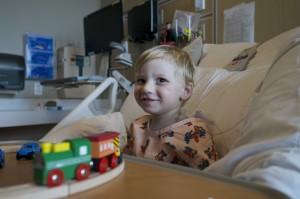
Clark loved having his trains at the hospital. We were able to fit an entire loop on his dining table, and then run a battery powered train continuously. He would watch it go around for hours!

By the 4th day, the doctors were finally able to identify the strain of bacteria. Unfortunately, the antibiotics Clark had been on up until then were the wrong ones!  Clark had a rare bacteria that the current antibiotics were not effective at killing. The bacteria, Pseudomonas, can be normally found in dirt, plant spores or just blowing around. Most people are not affected by it, but as it so happens, this bacteria loves broviac’s, and people with compromised immune systems.

Since Clark wasn’t showing many signs of an infection (no fever and he was happy and energetic), the doctors assumed the bacteria was harboring inside of Clark’s broviac. So they decided to have his central line removed. This on its own is not a big deal since we were planning on switching it out for a double line this week anyways. The problem was that we would not be able to put the double line Broviac in until the bacteria is completely out of Clark’s system. And without some type of central line, giving Clark infusions or medicine would be difficult (or near impossible).

So, during the surgery to remove Clark’s original broviac, Clark had a PICC line inserted in his arm. This is basically a mini broviac, or catheter that was inserted in his arm to receive his medicine, or blood products if needed.

Late on the 8th night (Monday August 4th) we were finally sent home with oral antibiotics and instructions on how to care for Clark’s PICC line.  We were very glad to be heading home.  It gave us 2 days to plan for Clark’s upcoming BMT, and more importantly, some much needed TLC with Connor.

A little bump in the road

With less than 2 weeks to be admitted for his BMT at UCSF, our only goal is to keep Clark free of colds and sickness, as these are the only things that can derail the upcoming procedures.  But even with our absolute best efforts, we couldn’t seem to catch a break for our young boy.

After a great Sunday afternoon celebrating Connor’s 4th birthday, Clark woke up at 10:30pm crying and vomiting, with a fever slightly over 102 degrees. This was a panic moment for us.  Fevers this high generally mean there is an infection. Since Clark has a low white blood count (WBC), he cannot fight off bacteria infections on his own. We called the hematologist, and (as expected) they told us to go to ER in Oakland immediately.

We really don’t like going to ER.  It could be deadly for Clark to wait in the general waiting room filled with other sick patients and furniture covered in germs. Whenever we go into ER with the kids (aka the little germ magnets), we try to avoid touching anything and keep the sanitizer close at hand.  Lucky for us and him, since Clark has a compromised immune system we are put on the fast track after arriving in ER (where others may wait for hours).   With Clark being immunocompromised, we are given a private room (with a door) usually within 10-15 minutes.

As soon as we entered our room in ER, Clark had a blood culture taken. The blood culture determines if he has a bacterial infection, and if so, what type of bacteria infection he has. This usually takes 24 hours to get a negative or positive result plus another 24-48 hours to find out what strain of bacteria it is.  As well, he also received a blood draw for his complete blood count (CBC).  The CBC is to check his WBC count. If his numbers are high enough, he can fight off most infections on his own.  The CBC test generally comes back in only an hour.

After taking these, they immediately started Clark on an antibiotic delivered intravenously through his broviac. They do not mess around with immunocompromised children.  By giving this treatment immediately, his body can start fighting off possible bacteria before even getting the culture test results. As well, if the bacteria is in his broviac line, by putting the antibiotics through the line they can also make it is also clean from bacteria.

Within an hour, Clark’s CBC came back, and his WBC was higher than normal. This was great news ! It meant his body was attacking the bacteria. It meant we could go home after the 1st round of antibiotics, and come back in 24 hours for 1 more dose.

However, as always, there was a catch.  The CBC also showed that his hemoglobin (hgb) was down to 6.4.  The doctors generally recommend we do a blood transfusion when Clark is under 7 g/dL. The low hgb is a complication due to his Aplastic Anemia. While this result had nothing to do with his fever of bacterial infection, it did mean we needed to stay in the hospital “a little longer” to receive the transfusion.  We knew there was nothing little about the stay we were having.

The reality is that it can take some time to get a blood transfusion. There is time needed for the logistics of acquiring the blood for the transfusion, as well as the time needed to do the procedure itself.  First the doctors need another blood draw for confirmation of blood type. Then they need to order the blood from the blood bank, which usually takes a couple hours.  Finally, when they hook Clark up  the transfusion, the process of transfusing usually takes 3-4 hours.

We immediately knew we were not leaving the hospital that night.

Thankfully we have been through this before, so we knew it would be beneficial to request to be admitted into a room on the pediatric floor (rather than staying in the less comfortable ER). And as we expected, by the time the transfusion was complete it was 10am on Monday morning. Patrick and I (and Clark) were all exhausted from the long night.

And then we got more good news… The doctors decided it would be best to keep Clark “just a little longer” so they could administer his 2nd dose of antibiotics.

By the time they administered the 2nd dose, we were finally sent home.  It was 6pm Monday evening.  We had been in the hospital for almost 20 hours!!  At least we were able to come home early enough to give us a chance to play with Connor, have some dinner, and sleep in our own bed.

That is, until the phone rang at 3am with the blood culture result (to be continued…)

What does it take to be a bone marrow match?

I get a lot of great friends and family asking if they can be the ones to donate bone marrow to Clark for his transplant. It’s a great question, and we really appreciate the offers, but unfortunately most will not be a match.

About 70% of patients who need a transplant do not have a suitable donor in their family. Half of Clark’s HLA genetic markers are inherited from myself (his mother) and from Patrick (his father). Each sibling has only a 25% chance of matching. We already know that Connor is not a match (unfortunately). Likewise, it is highly unlikely that other family members will match Clark. Under very rare circumstances, family members other than siblings may be tested.  Case in point might be where 2 sisters married 2 brothers.  Cousins from the other couple might be a great match.  No such luck in our case.

Human leukocyte antigen (HLA) typing is used to match Clark with a donor for bone marrow. This is not the same as ABO blood typing. HLA is a protein – or marker – found on most cells in your body. Your immune system uses HLA markers to know which cells belong in your body and which do not.  It is “acceptance” that is being sought after here.  If the body rejects the transplant, it can be a catastrophe.

There are 12-13 genetic markers that are tested to define a bone marrow “match”. The odds that two random individuals are HLA matched exceeds one in 20,000.  This is why it is so important for eligible donors to register.

The factors for Clark are largely Irish and German (with some Welch, Norwegian and other European Countries). So if you are full Irish, or half Japanese, then you most definitely won’t match. But if your grandfather was Irish, and your grandmother was German, there might be a match there. We are basically looking for people that might have been from the same “village” (back in the days those existed).

However, even if you are of a different nationality than Clark, please consider donating “in kind” for Clark. Donating actually isn’t a huge procedure, and you very easily could save someones life.

Nosebleeds: How something so simple, is now… complicated

When Clark’s older brother got a nosebleed, we quickly calmed him down, pinched his nose and tilted his head forward.  The bleeding usually stopped within a minute and we would then dust him off, and send him out into harms way again.

With our second child, Clark, it is amazing how different this simple injury has changed for us.

Clark woke up the other day with bloody sheets and a nose slowly oozing red. There are lots of reasons he might have a nosebleed:

  • banging his head accidentally when he was sleeping
  • itching his nose
  • dry summer air
  • etc…

As well, of course, spontaneous nose and/ or gum bleeds from his Aplastic Anemia.  Low platelets is one example of something that might cause this.

Nosebleeds can also be difficult for someone with hemophilia since it is difficult to stop the bleeding.  Couple this with low platelets, and we figured we were just seeing a little more active bleed than normal.

Clark was scheduled to get his platelets that day, so at first we weren’t concerned at all.  Our first thought was: get him his regular platelet transfusion, and it should help stop the bleed.  Clark received the platelets, and all was looking well. He had a little more color in his cheeks, and the bleeding has stopped.

Until the drive home. :(

When I arrived home and took Clark out of his carseat, I noticed that his nose had started bleeding again and blood was all over his face. I immediately gave him a dose of Amicar knowing that this drug helps to prevent saliva/ mucous from breaking down a clot. Unfortunately, an hour later and his nose was still bleeding. A quick call to the hematologist has us trying to squeeze Clark’s nose shut for 15 minutes. (This, let me tell you, Clark did not like!  I think he may never let us touch his nose again.)

Squeezing didn’t help either.  So I ended up driving back to the clinic for Clark to get an infusion of Factor VIII, hoping this might be the issue.  (Factor VIII gives him the clotting factor that hemophiliacs are missing.)  While at the clinic getting the factor treatment, we did another CBC.

This is where things got interesting.

It turns out Clark’s hemoglobin (red blood cells) were low.  He was at 6.7 and the doctors like to transfuse at 7 or less (normal healthy people are closer to 10).

At the time, my first thought was what would this have to do with it?  Red blood cells aren’t used for clotting.  When you are low on red blood cells, you are getting less oxygen (carried by red blood cells) to your organs, which can manifest itself in a child being lethargic.   No signs of that with Clark at this point.

But what we didn’t think about, was the fact that while Clark’s energy appeared normal, he was maintaining this energy by having his heart work twice as hard to get oxygen around his body.  Which means his blood pressure was also elevated.  As such, his nose wasn’t able to heal due to the pressure of his blood circulating around his body.  Think of it this way, if you had a bloody nose, and then started to sprint as hard as you could – would your nose heal?  No, it would probably start to gush.  This was effectively what was happening to him.

Sure enough, once he got his blood transfusion, his nose stopped bleeding altogether, and he (and I) could finally calm down and relax.  Once again proving, that with a Hemophiliac / Aplastic Anemia child, even the simplest of issues can cause huge problems.

20 hours in emergency

It has taken a couple trips to the emergency room to have us re-orientate our thinking around what preventative measures are best for Clark.  One example of this was when we realized having him wear a helmet was better than having to take him into the hospital for random head bumps.  In our latest visit to ER, we’ve also realized that drawing blood or giving medicine with needles or an IV to Clark, also required a new approach as well.

After Clark’s first bone marrow biopsy, we were instructed that if he got a fever above 101.5 after the surgery, that we should immediately call the doctors office and let them know. A fever could mean there is an infection, and since Clark has a low white blood count, he would be unable to fight off bacterial infections without strong antibiotics pumped directly into his blood stream.

Exactly 1 week after the biopsy, Clark had a temperature of 102. So, while we were not surprised when the on-call hematologist sent us to the ER, we were still very nervous about getting blood drawn or an IV.  Patrick and I have learned from previous blood draws, that Clark was not an easy boy to stick with a needle. He has cute chubby arms with tiny hidden veins.

We arrived around 7pm, and of course the first item on the agenda – a blood draw. They wanted to check his CBC (complete blood count) and to check for any obvious bacterial infections.  This initial blood draw took 3 hours, 4 pediatric nurses, 1 anesthesiologist and finally a lab technician to get the minimal amount of blood needed for a small vial.  Through this first adventure, they had blown 4-6 veins in the largest and easiest spots to access.

Knowing more was coming, this was a disheartening start to our visit.

Then came another challenge.  While in ER, the nurses wanted to put in an IV line.  Why, we asked?  Because it “might” be needed later in the visit.  At first I refused, explaining how hard it was to get to Clark’s veins.  As well, I knew that:

  1. they most likely would not get an IV in, and would ruin more veins in the process
  2. or, the IV wouldn’t stay in a 1 yr old who is thrashing around

But fighting with ER nurses takes wisdom and practice, and on this visit, I was still learning both.  So sure enough, they placed the IV while Clark screamed and fought.

The ER doctor also wanted to give Clark a catheter for a sample of his urine (to check for a bladder infection). This I definitely had to question.  If the staff can barely get a needle in my 1 year old’s arm, I’m definitely not letting them jam a catheter into his junk.  Luckily this was one small skirmish we were able to win.  As it turns out there is a cute little bag that they can use to collect his urine sample. No needles, just a harmless sticker. I guess my persistence paid off. The sample was ready a bottle of milk and an hour later.

By the time 11pm rolled around, Clark’s blood tests came back.  He had low WBC, but with high Neutrophils (900) which is the part of the white blood cell that attacks bacteria.  So some good news, we did not end up needing the antibiotics…

BUT….

Unfortunately the tests did show that Clark’s platelets were dangerously low at 14,000 (normal is 150,000- 450,000).

Because of this, we were admitted at midnight to the pediatric ward for a platelet transfusion.  Most transfusions are done when the platelets drop below 10,000 but extra caution is needed because of Clark’s hemophilia. Platelets and Factor VIII both affect how well his blood will clot. At this point Patrick and Connor arrived at the hospital for support and for more information. Thank goodness, I couldn’t have gone through this without Patrick’s help.

As we had predicted, the IV put in from the ER nurse didn’t stay in.  Another vein ruined, and one fewer spot to place another IV.

Nurses have a funny way of slighting each other.  In this case, our pediatric nurse said that the ER nurse had wrapped Clark’s IV using the same practices as an adult, and not the appropriate method for a child.  My first thought was, why not go down and tell the ER nurse this info – maybe someone else would be saved the suffering of their child being repeatedly being poked with needles?

As this “knowledgeable” pediatric staff started to place a new IV into Clark, we learned the hard way that the best medical care Clark can possibly receive, starts with determination and persistence from his own parents.

Over the next 10 hours, multiple attempts were made to put an IV into Clark.  Each time escalating to a new set of “experts” on placing IV lines.  Pediatric nurses, to ER nurses, to pediatric doctors, to anesthesiologists. By the time the anesthesiologists (who we do consider experts) arrived, they were left with the smallest and remotest of veins.  Again, no luck.  Clark had been in the ER for 15 hours at this point, being woken up every 2 hours for doctors to attempt poking him again.  And each time, there would be 4 of us holding him down while he looked directly at us, pleading for the torture to stop.

And so at this point it stopped.

After the 4th attempt at the new IV, we said stop.  That was enough.  We questioned how badly he needed platelets, and the answer came back that we probably didn’t need the transfusion.  Apparently it wasn’t worth escalating the procedure of placing an IV into his bone.  The next step would have been to push a needle directly into Clark’s thigh bone, and feed directly into his marrow.  They felt that the platelet count was high enough not to warrant this emergency tactic.

When we finally left the hospital the afternoon of the 2nd day, it was with a tired little boy full of holes and low on platelets. His little pokes turned into bruises at every needle site. It took 2 full days of recovery before Clark is turning into his regular, happy, energetic self.

DSC03303

Here’s the benefit of what we learned from this visit:
  1. Pediatric anesthesiologists are our best bet for placing an IV in Clark, although we’ve had success with regular anesthesiologists in the case a pediatric version isn’t available.  Everyone else is simply not allowed to try.
  2. When needing to pull blood, ask for someone from the lab to come up to do it.  They are experts with pulling blood, as it is all they do all day, every day.  We’ve had 100% success with these folks doing the work.
  3. NO TRIAL RUNS!  Don’t waste time with nurses or doctors (ER, pediatric, etc…) attempting to place an IV or pull blood.  SAY NO WHEN THEY SAY: “I’ll just take a look”.  This is code for “I’m better than the last nurse…”, but believe us, it isn’t true.  The truth is that each attempt just ruins the veins that are needed by the anesthesiologists or lab techs.
  4. Arms are the best bet for placing a line.  Forget the ankles.  We have had 0% success with placing lines in the legs.  As well, attempt to place a line in this area is extremely painful for Clark, as well as awkward to attempt to place.
  5. There is a ultrasound machine used in surgery to help Pediatric Anesthesiologists place lines in small children.  Suggest this if the risk of placing a line is high.

Getting a Bone Marrow Biopsy

To determine if Leukemia or Aplastic anemia is causing Clark’s red blood cells, white blood cells, and platelets to be so low, a bone marrow biopsy and aspiration must be done.

Bone marrow is the soft tissue found in the hollow part of most bones and it is responsible for making all three of these types of blood cells.  A bone marrow biopsy is the removal of soft tissue, called marrow, from inside bone. This is used to test for Aplastic Anemia. A bone marrow aspiration is the removal of a small amount of this tissue in liquid form for examination. They use this to test for Leukemia.

Patrick and I were very worried, since this was Clark’s 1st time under anesthesia. About 15 minutes before the operation, Clark was given a liquid calming medicine, nicknamed “Drunk baby”.  This caused him to be “out of it” enough to allow doctors to take him away.  Thankfully Clark’s operation only took about 20 minutes. We didn’t experience any complications and no allergies to the light anesthesia. It was given to him as a gas, and light enough that he didn’t need a breathing tube.

The hematologists were fully aware of Clark’s operation and were not concerned about bleeding since the operation is similar to having blood drawn. No factor was needed. We also made sure the surgeon knew about Clark’s hemophilia, so after the operation a compress bandage was put on to help stop the bleeding quickly. He bled through it in about 15 minutes, but after a bandage change there were no more bleeding issues. He hardly even had a bruise.

Clark woke up from the anesthesia very groggy and incredibly upset. He flopped around and cried for a good 30-45 minutes. We’ve talked to several doctors and parents, and apparantly this is normal for children. Playing with ice chips and eating a popsicle helped calm him down.

Confirmation on his condition was given to us in 3 steps.  The next day, we were given news that Clark most likely did not have Leukemia  (a 95% chance that he didn’t have it).  A couple days later, we got a confirmed negative on Leukemia after looking at his marrow.  Now to wait for the results for the Aplastic Anemia. These results should be here in 5 days to 2 weeks.

On Friday (5 days later) our hematologist called us to say that Clark did not have Aplastic Anemia.  This was a surprise as we were only ever told that these were Clark’s only options.

Unfortunately… this type of science isn’t black and white, and contains a lot of gray area.  In this case, Aplastic anemia had not yet “declared itself”.  This came when we had our second bone marrow biopsy.

In the beginning…

April 8th, 2014 was when the real adventure began for our medical journey with Clark.  While we had several key medical issues leading up to this date (Clark’s mild hemophilia, problems with his left eye, head injuries,etc…), it was on this date that we received confirmation that the smaller issues we were seeing might be tied to a bigger problem.

Two days earlier, Clark had a “comprehensive exam” at the Hematology clinic. A comprehensive exam is a way for us and Clark to meet all our doctors, nurses, physical therapists and social workers in the hematology clinic.  As well, it gives us a chance to address any questions we may have about Clark’s hemophilia as well as his physical and mental development.

In conjunction with attending the comprehensive, it is routine for the patients to have a blood draw and a CBC (complete blood count) done. This is to check factor VIII levels, platelet count, WBC (white blood count), RBC (red blood count) and liver functions.

On April 10th, after getting the results of the blood draw, alarms went off.  Our doctors noticed that Clark had low platelets, low WBC and low RBC. We were told to go in immediately for another round of labs to see if there were any mistakes. 3 separate blood tests all confirmed that his numbers were low, and decreasing.

2 conclusions were immediately drawn.

  • Something was VERY wrong
  • It might be either Leukemia or Aplastic Anemia.

We were immediately scheduled for a bone marrow biopsy to check for both of these diseases.  At the age of 1, Clarkie was to go into his first surgery.