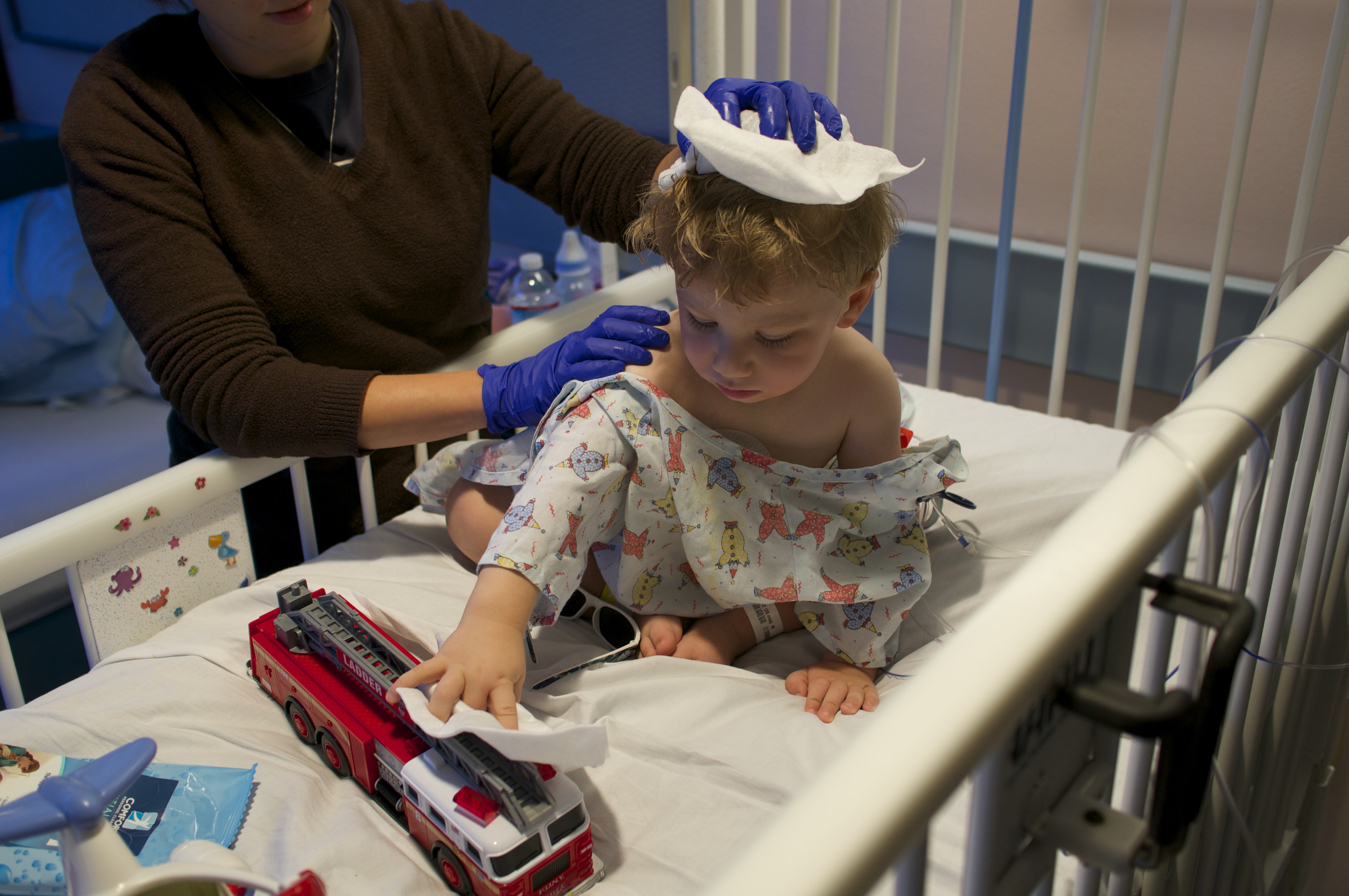
And now we finally know…

There has been one outstanding mystery we’ve been puzzled by.  Why did Clark’s retina detach, and why did it go so bad, so quickly?  Was it caused by DKC specifically, or was it an accident and DKC was the reason it didn’t heal?  Was it totally unrelated?  We really weren’t sure up until about a week ago.

On August 29th, UCSF had a visiting scholar give a speech on Dyskeratosis Congenita (DKC), Dr. Tony Xiao.  Dr. Xiao was a visiting dermatologist who was studying the skin and nail abnormalities with BMT patients. After spending a month with the BMT team at UCSF, he wanted to speak on a topic that covered both dermatology and bone marrow transplants.  DKC was the perfect topic.  Some of the early signs of DKC are fingernail and toenail dysplasia, leukoplakia of the mouth, and pigmentation abnormalities of the skin.

Dr. Xiao came by to take a look at Clark and talk to us.  My first question to him was whether he thought Clark’s detached retina in his left eye was due to his DKC? He responded by saying, “…typically no.  Eye problems are not usually associated with DKC, unless there are brain calcification as well… ”

To which I answered, shocked, “actually, he has brain calcifications…” According to a CT scan we had 8 months ago as well as an MRI 3 months ago, Clark has scattered spots of calcification throughout his brain.  So I was instantly curious… “what does that mean??”

Dr. Xiao then said,  “Oh… Then that means that Clark has Revesz Syndrome.”

And there it was… an exact diagnosis (or at least as exact as we can expect with this relatively unknown condition).  Clark has Revesz Syndrome.  We finally know exactly what we are dealing with.

Revesz syndrome is a specific variant of Dyskeratosis Congenita. 

Features that distinguish Revesz syndrome from general types of dyskeratosis congenita include:

  • excess fluid in the retina of the eye (exudative retinopathy)
  • brain abnormalities such as cerebellar hypoplasia
  • cerebral calcifications that lead to unsteadiness and balance problems
  • Growth retardation both in utero and after birth
  • Cognitive impairment is greater as well

Up until this point, we really didn’t have any correlation between the DKC and his eye problems.  But finally bringing it all together, we can better know what to expect in the years to come.

Why did it take so long to get here? From what we understand, DKC is a very new disease. Every doctor we spoke with about DKC had to run into a darkly lit library and read up on it before answering any of our questions. So most of the answers we received were just paraphrasing of medical journals, rather than speaking from experience. It was nice to have a team with enough practical experience to finally put the two together.

Thank you UCSF!

BMT: Isolation (Day +19)

Today was not as boring as some of our previous days. Clark woke up bright and early, ready to play. Things were moving along nicely, until about 8:30am when he started throwing up.

Yesterday, Clark stopped taking Zofran, an anti-nausea medication that he had been taking every 8 hours for the last 4 weeks. We decided to stop it because Clark has been doing so well, and we didn’t think he needed it anymore. Now we have the Zofran on open order as a need-to medication. Maybe he just needs to be weaned off of it?

With Clark’s nausea, and also the fact that Clark woke up too early, Clark was not in the best mood. We played by the window for about 30 minutes before Clark’s 1st temper tantrum. I didn’t want him flailing around and falling on the floor, so I had to take him back to the crib. He continued to scream at me until he wore himself out. Then we just cuddled until he was happy again.

What is missing in this picture?

One MAJOR benefit to Clark not taking Zofran, is that it was his last medication taken through IV. Because of this, Clark was unhooked from his lines! Freedom! (Said in a yelling sing-song way). He will be “Hep locked” every 24 hours. Meaning that they will administer 2 mL of heparin into his broviac lines to keep them from clotting. This is easy, and something we will be doing ourselves once home.

Now, onto the latest ANC news. Clark is at 2440 today!! Whaaaat!? This is in the “normal” range! My immediate reaction: “Umm, doc, are you sure you didn’t calculate that wrong? Like maybe off by a decimal point? Did he go down to 240?”

No! His ANC increased that much!

Let’s talk about some more numbers. Starting with platelet counts. Since we found out about Clark’s Aplastic Anemia a few months ago, he has been having regular CBC’s. These showed that on their own, Clark’s platelets would drop down to 0. He wasn’t producing enough (if any) to keep them at a safe level. In a normal, healthy person, platelets are between 150,000 to 400,000 mcL.

Since arriving at UCSF, Clark’s platelets continue to drop. Once they reach 30,000 or less, Clark usually has a platelet transfusion to bring them back up. Before chemo, he was receiving a transfusion about every 7 days, and since chemo, he has had a transfusion approximately every 3 days. Just last week, Clark’s platelets started to drop at a slightly slower rate.

Then, at day +17, Clark’s platelets dropped to 24,000. The plan was to give him a platelet transfusion the following day. But on day +18, they magically jumped up to 38,000! And now today, they are holding up at 38,000!  Does this mean his new marrow is producing platelets now? Most likely, but it is still early to tell.

Things are getting super exciting… Rumor has it, we may be discharged soon!  More to come…

BMT: Isolation (Day +18)

Drum roll please….  Today, Clark’s ANC reached a whopping 740!

Way to go Clark! I was surprised, amazed and so full of joy when I heard the wonderful news. When we get 3 days with ANC above 500, lots of things change.  Here are a couple examples…

  • Connor can come visit (actually come in the treatment room), as long as he doesn’t have any signs of a cold.
  • Patrick and I can eat and drink in the treatment room.  No longer do we have to sneak out into the anteroom for a coffee or a snack.
  • Clark can start to be prepared to return home. He won’t be released right away, but they will definitely start preparing to send him home.  And in our case, this may happen fairly quickly given that he is eating and drinking normally, and has most of his medication orally.

Putting the boys together again raises some “new” issues, but we’re lucky in some respects.

Since the boys were born, I have been on-time with their immunizations (we still space them out when we administer them, we just don’t “deny” them any). There is still a scare (depending on who you talk to) that the vaccines themselves can cause harm, such as autism or mercury poisoning. Some parents still refuse to vaccinate at all!  After spending hours reading both points of view, Patrick and I decided that the benefits of getting the boys immunized outweighed those of forgoing them.

I am very glad we chose this path. Right now, Clark has the immune system of a baby born 4 months premature. When we “wiped out” Clark’s bone marrow with chemotherapy, we also effectively “wiped out” the vaccines in his blood.

As some of you are probably aware, you can’t give a baby all their vaccines right away. During the time an infant is born, and when you can give them their first vaccine, the baby is completely exposed.  Normally this timeframe is covered by receiving their mothers antibodies and supported immune system while breast feeding.   That won’t be an option for Clark, since I stopped nursing him 8 months ago.  The good news is that we don’t have to wait as long as when he was an infant, and we can “fast track” his immunizations (and still keep them spaced out).

The reason I am so glad the boys are both up-to-date with their shots, is because of Connor. Clark is not supposed to play, or be near other children that haven’t been immunized. Common illnesses like measles, chicken pox or whooping cough could kill Clark if he was exposed.  We are lucky that Clark’s risk of catching these, or more deadly diseases, is greatly minimized due to the fact that Connor won’t be exposing them to Clark.

Similarly, none of us (Patrick and myself included) have ever had the flu shot. This year will be our exception. Since neither Patrick, nor myself work with the elderly or other immune compromised people, we didn’t feel it was necessary. When it comes to getting the flu, we had the mentality of “if it doesn’t kill you, it will only make you stronger!” Since we are now caring for an immune compromised child, we have to become much more practical about these things.

BMT: Isolation (Day +17)

So, as it turns out, there are a couple reasons why the doctors aren’t as “excited” as we are at the rising ANC numbers.

From our perspective, we assumed going from 0 ANC to 400 ANC (today’s reading), meant that the bone marrow cells must have taken root and were growing and producing white blood cells and neutrophils.

But this isn’t quite true.  At least, it isn’t the only scenario!

First… It is possible the body’s “old” bone marrow is the one growing and producing the ANC we are seeing.  In which case, we’ll get to a number somewhere between 400 and 600, and it won’t go any higher.  We’re looking forward to ANC counts well above 1000, and maybe approaching 1500 to 2000 (on a regular basis).

Second… We assumed the new marrow must be in and growing, and that the risk of rejection had past.  But not necessarily true again. Bone marrow rejection can occur many months after it has been given. A sensitive DNA test known as the chimera test will be done at the 30 day mark to see if the transplanted bone marrow has taken root, and is in fact producing it’s own blood cells.

Just when you think you understand this process – it gets more complicated!

DSC09288Clark got some time with Grandmom today, while Connor was able to spend time with Mom and Dad.  We were very lucky to be able to both be out of the hospital at the same time, and spend time with Connor.

Beth started by walking Connor through Golden Gate Park, and when Dad caught up, the three of us went to the California Academy of Science together.  The Academy of Science is just down the road from UCSF, and we can walk there in literally 10 minutes.  While the entire visit was under 2 hours, it felt like a whole day of fun.

T-Rex at the California Academy of Science

This was my first visit, so I have to take a second to note how amazing and awesome the Cal Academy of Science is.  It is a zoo, rain forest, museum, aquarium and planetarium – all wrapped into one building!  On top of this, they have a ton of educational presentations and special events.  If you can’t learn something new every time you walk into this building, then you don’t have a pulse.

DSC09313On this particular visit, we spent time downstairs in the aquarium side of the building.  They literally have multiple walls of fish, lit up with UV.  The fish look amazing.  Connor’s eyes were so wide, I was worried they might fall out of his head.

Upstairs, they have a swamp exhibit where we got a chance to see an alligator up close.  But not any alligator, an albino alligator.  Yes, it is real.  And yes, it is white.  Double wow.DSC09324

BMT: Isolation (Day +16)

I’ve been anxious all day waiting for Clark’s ANC. Waiting, and waiting, and waiting…  It is so exciting to see progress on a daily basis.  While not quite a light at the end of the tunnel, it certainly points to good progress that we can measure.

Finally the doctors came for rounds, only to tell me that the results haven’t come back yet.  Arrg! They said they would come and let me know as soon as they found out. So, 2 hours later, I asked again. After calling down to the lab, we were informed they didn’t have his (complete blood count) CBC! Arrg again!! Somewhere along the line, Clark’s CBC was misplaced. Bummer.

It’s actually interesting… The doctors are just as eager to find Clark’s ANC, so they decided to have another CBC drawn, rather than sort out what happened to the first vial. Our lovely nurse walked the small vial of blood down to the lab herself, and handed it directly to the person who tests. This way we didn’t have to worry about another loss.

Finally at 7pm, we received Clark’s ANC.  And sure enough – he is up to 390! Not as high as I was anticipating, but still an upward trend! Still great news, and all in all, still a great sign.

Since Clark is heading in the direction of heading home, Patrick and I thought it would be a good idea to learn the “rules” for Clark’s isolation as well as what we have to prepare for in advance. One of the staff members stopped by to give us a handout (more like a book!) to prepare. She also stayed by to answer some questions. Without re-writing the book to you, here are some highlights to look forward to:

What does “isolation at home” REALLY looks like:
– Clark can walk and play outside! With a mask on.
– We must avoid crowds, such as grocery stores, church, restaurants etc..
– We’ll have to void sand, wood chips and dirt. Grass is ok.
– We’ll have to stay far away from construction sights (dust in the air).
– Friends can visit, but only if there are ZERO signs of illness. This includes chicken pox exposure and cold sores. It is hard to tell if children are coming down with an illness, so it is advised to keep them away regardless.

Home preparation:
– Have all carpets steam cleaned
– Do a good “spring” clean. Making sure to dust crown molding, on too of the fridge etc…
– Install new air filters
– Change shower curtain, then continue to wash it every other week.
No live Christmas trees (they are killing me here)

The book continues with, Medications, Foods to avoid, Signs of infection, Who to call in an emergency, etc…  It is surprisingly more than we thought!

BMT: Isolation (Day +15)

Another full day today…

Clark was entertained by the speech therapist and the physical therapist! The speech therapist helped reinforce sign language with play. Using the sign while saying the word gives Clark the option to sign if he doesn’t know how to say it. With time, he will naturally start saying the words instead of signing. We had lots of success with signing with Connor, but Clark appears to be stronger in his comprehension, which has led him to require signing less.  But now that he is trying to communicate back to us, signing is becoming very important to allow him to “talk” to us.

Physical therapy is working on having Clark walk around, squat, balance and bend over. All of which Clark seems to be thriving in. Any excuse to get out of the crib and do something, looks to be of great enjoyment to Clark!

I’m sure you are all impatiently waiting to hear about Clark’s ANC (at least I was)…so I won’t keep you any longer. Today Clark had an ANC of 370! Much higher than Clark’s 140 yesterday…..but, this is still nothing to get excited about, yet. With most patients on the recovery side of a BMT, there doesn’t seem to be a common trend when it comes to their ANC rising. Some kids numbers increase strong and steady, some take a while to get going, while others tend to fluctuate or plateau before reaching 500.

Having an ANC of 500 or greater, helps reduce Clark’s risk of infection. A “normal” ANC is 1500 to 8000/mm3, so we still need to be extremely careful to prevent Clark from getting sick. This is one of the reasons why Clark will still be in isolation for 4-6 months after we leave the hospital.

500 to 1500 is considered the ‘safe” zone. Meaning Clark is still prone to infection, but his body is able to still fight back. There are some perks to Clark’s ANC reaching 500. Such as, Connor will finally be able to visit in the room! Homemade food can be brought in for Clark and we can eat in the hospital room! Clark will also be able to walk around the BMT unit with a mask on! All exciting bouts of freedom which all of us will enjoy.

BMT: Isolation (Day +14)

We had a little surprise today. When Clark’s numbers from his daily blood tests showed up, he had a number greater than zero for his ANC (absolute neutrophil count).  ANC is effectively a number that is calculated based on white blood count (WBC) times neutrophils.  ANC represents the virus fighting power in Clark’s blood.

Needless to say, those cells can’t be transfused, so they only come from one place… Clark’s bone marrow!! Today, Clark’s ANC was 140, up from 0 just a couple of days ago.

Is this engraftment? Technically, no.  The doctors consider it engraftment once Clark’s ANC  reaches 500 for 3 consecutive days.  But is this a good sign? Absolutely YES!  The ANC will continue to fluctuate as we go forward, we just need to see an upward trend over multiple days.  If tomorrow Clark is only at 50, that is fine and is still completely normal.

We had another milestone today; Clark started Cellcept orally! He had been taking it through IV, but they decided to switch him over based on his great progress. Most kids start switching to oral meds a bit later in the process,  due to mucositis or nausea, which lead to emesis. Clark has had a few bouts of emesis, but nothing serious enough to prevent him from taking oral medication.

Clark also had a visit from the speech therapist (ST) today. Clark is now 21 months old, but isn’t saying any words. We thought it might be a good idea to see a ST to evaluate Clark, and to learn if there are ways we can help him out.  Personally, I wasn’t too concerned since Connor was about 24 months when he decided to start speaking. But, since we are here, and the ST was available, I thought this might be a good time for an evaluation.

TIL a ST does a lot more than teach someone how to speak, they find out WHY they aren’t speaking. For example, if Clark was deaf, he would have more difficulty learning to speak than others. There can also be physical ailments such as a cleft tongue or a voice box that isn’t fully developed. Or there is the possibility of a mental disability that can hinder speech.

Thankfully, in Clark’s case, it just seems to be a slight delay in speech, unrelated to a more serious problem. He does not have any hearing loss. He can make sounds, proving that it isn’t a physical problem, and he fully comprehends what we are saying. I was given some tasks to preform for a few months, or until Clark starts speaking. We will continue to teach him names of body parts, learn animal names (from looking at pictures) and make sounds together. We can make animal sounds or have him copy simple sounds that I make. All in all, this feels more like a game instead of work. :)

BMT: Aplastic (Day +13)

Yesterday, Clark’s red blood cell (RBC) count was 8.0. We were expecting to give him a RBC transfusion today, but surprisingly his RBC count was 8.3 today! Even though this may look like engraftment, it most likely isn’t since RBC are one of the last blood cells to take hold. What most likely happened, is the small sample of blood that was taken yesterday just happened to have slightly less RBC’s than today’s. Nothing more. Don’t be discouraged though. In my mind, the less transfusions he has, the better.

Clark is still looking and feeling great! Today was slightly less boring than normal, since he had a small episode of emesis this afternoon. Oddly, immediately after we changed his sheets and cleaned up, Clark immediately asked to eat!

Clark was also visited by the physical therapist, book fairy and the music man today! He even learned a few cords on the guitar!

BMT: Aplastic (Day +12)

Happy Labour Day!

Patrick, Clark and I spent the day together.  While Patrick and I were talking today, we did a quick calculation.  Including our first 2 surgeries to fix Clark’s mysterious bacterial infection and put in the 2 lumen broviac, as well as the BMT, we have been in hospitals for almost 35 consecutive days!!  Wow, it has been a long time.  Lots of ground covered, but still lots to go!

We are now in the “zone” for engraftment.  There are no expectations for how soon we might see the new bone marrow take root, but somewhere around 14 days, give or take, we expect to see Clark’s neutrophils and ANC rise.  Today was the start of the “earliest” we could expect to see signs.

Once we see growth we move into the next phase, called “Isolation”.  Isolation starts at the hospital, but continues at home for months after we leave.  More on this in the coming weeks – but think of it like “house arrest” with the family. Ha, ha…

DSC09168We have to give Clark a special clorahexadine bath every day, to ensure we kill any fungus or bacteria that might be growing on his skin.  Clark has decided he likes to wash his truck while I wash him.   That truck is so shiny and clean!

BMT: Aplastic (Day +11)

Clark continues to eat and drink in great quantities, and isn’t showing any signs of mucisitis.  His numbers are at rock bottom and he is susceptible to just about anything, so we are just very lucky that he is in great spirits, eating, and not losing any hair!  In fact, his weight just returned to his admittance weight.  Go Clark!

Clark had a fun day with Grandmom and Daddy today.  Grandmom came out to see Clark while Connor spent the day with Beth.  Clark played on the bed, work on puzzles and had books read to him.  He was delighted to have a change of pace and someone new to play with.

IMG_0026Beth and Connor spent some extra special time together today.  The UCSF Benihoff Children’s hospital is 3 blocks from Golden Gate park.  And it is only a 20 minute walk to a lot of the attractions for kids that are in the park.

Today, Connor got to ride on the Carousel, and visit the California Academy of Science.

The Academy is a “hands-on” museum with tons of exhibits for all ages.  They have some pretty cool attractions.  One of cooler ones is the “shake house“!  This is a simulator that lets you feel what 2 historical earthquakes feel like.  The two earthquakes it simulates are the 1989 Loma Prieta (6.9 on the Richter scale), and the great San Francisco earthquake of 1906 (7.9 on the Richter scale).   After our 6.0 Earthquake in Napa Valley a week ago, Connor has been very interested in earthquakes.

This visit to the Academy was especially exciting for Connor.  He has been persistently asking his Mom and Dad for an opportunity to see dinosaur bones.  Sure enough, as soon as they walked in the door, what to Connor’s wondering eyes should appear?

Dinosaur bones!!
Dinosaur bones!!

A full size tyrannosaurs Rex skeleton!  His facial expression says it all:

Happiest.
Boy.
On.
Earth.