BMT: Isolation (Day +17)

So, as it turns out, there are a couple reasons why the doctors aren’t as “excited” as we are at the rising ANC numbers.

From our perspective, we assumed going from 0 ANC to 400 ANC (today’s reading), meant that the bone marrow cells must have taken root and were growing and producing white blood cells and neutrophils.

But this isn’t quite true.  At least, it isn’t the only scenario!

First… It is possible the body’s “old” bone marrow is the one growing and producing the ANC we are seeing.  In which case, we’ll get to a number somewhere between 400 and 600, and it won’t go any higher.  We’re looking forward to ANC counts well above 1000, and maybe approaching 1500 to 2000 (on a regular basis).

Second… We assumed the new marrow must be in and growing, and that the risk of rejection had past.  But not necessarily true again. Bone marrow rejection can occur many months after it has been given. A sensitive DNA test known as the chimera test will be done at the 30 day mark to see if the transplanted bone marrow has taken root, and is in fact producing it’s own blood cells.

Just when you think you understand this process – it gets more complicated!

DSC09288Clark got some time with Grandmom today, while Connor was able to spend time with Mom and Dad.  We were very lucky to be able to both be out of the hospital at the same time, and spend time with Connor.

Beth started by walking Connor through Golden Gate Park, and when Dad caught up, the three of us went to the California Academy of Science together.  The Academy of Science is just down the road from UCSF, and we can walk there in literally 10 minutes.  While the entire visit was under 2 hours, it felt like a whole day of fun.

T-Rex at the California Academy of Science

This was my first visit, so I have to take a second to note how amazing and awesome the Cal Academy of Science is.  It is a zoo, rain forest, museum, aquarium and planetarium – all wrapped into one building!  On top of this, they have a ton of educational presentations and special events.  If you can’t learn something new every time you walk into this building, then you don’t have a pulse.

DSC09313On this particular visit, we spent time downstairs in the aquarium side of the building.  They literally have multiple walls of fish, lit up with UV.  The fish look amazing.  Connor’s eyes were so wide, I was worried they might fall out of his head.

Upstairs, they have a swamp exhibit where we got a chance to see an alligator up close.  But not any alligator, an albino alligator.  Yes, it is real.  And yes, it is white.  Double wow.DSC09324

BMT: Isolation (Day +16)

I’ve been anxious all day waiting for Clark’s ANC. Waiting, and waiting, and waiting…  It is so exciting to see progress on a daily basis.  While not quite a light at the end of the tunnel, it certainly points to good progress that we can measure.

Finally the doctors came for rounds, only to tell me that the results haven’t come back yet.  Arrg! They said they would come and let me know as soon as they found out. So, 2 hours later, I asked again. After calling down to the lab, we were informed they didn’t have his (complete blood count) CBC! Arrg again!! Somewhere along the line, Clark’s CBC was misplaced. Bummer.

It’s actually interesting… The doctors are just as eager to find Clark’s ANC, so they decided to have another CBC drawn, rather than sort out what happened to the first vial. Our lovely nurse walked the small vial of blood down to the lab herself, and handed it directly to the person who tests. This way we didn’t have to worry about another loss.

Finally at 7pm, we received Clark’s ANC.  And sure enough – he is up to 390! Not as high as I was anticipating, but still an upward trend! Still great news, and all in all, still a great sign.

Since Clark is heading in the direction of heading home, Patrick and I thought it would be a good idea to learn the “rules” for Clark’s isolation as well as what we have to prepare for in advance. One of the staff members stopped by to give us a handout (more like a book!) to prepare. She also stayed by to answer some questions. Without re-writing the book to you, here are some highlights to look forward to:

What does “isolation at home” REALLY looks like:
– Clark can walk and play outside! With a mask on.
– We must avoid crowds, such as grocery stores, church, restaurants etc..
– We’ll have to void sand, wood chips and dirt. Grass is ok.
– We’ll have to stay far away from construction sights (dust in the air).
– Friends can visit, but only if there are ZERO signs of illness. This includes chicken pox exposure and cold sores. It is hard to tell if children are coming down with an illness, so it is advised to keep them away regardless.

Home preparation:
– Have all carpets steam cleaned
– Do a good “spring” clean. Making sure to dust crown molding, on too of the fridge etc…
– Install new air filters
– Change shower curtain, then continue to wash it every other week.
No live Christmas trees (they are killing me here)

The book continues with, Medications, Foods to avoid, Signs of infection, Who to call in an emergency, etc…  It is surprisingly more than we thought!

BMT: Isolation (Day +15)

Another full day today…

Clark was entertained by the speech therapist and the physical therapist! The speech therapist helped reinforce sign language with play. Using the sign while saying the word gives Clark the option to sign if he doesn’t know how to say it. With time, he will naturally start saying the words instead of signing. We had lots of success with signing with Connor, but Clark appears to be stronger in his comprehension, which has led him to require signing less.  But now that he is trying to communicate back to us, signing is becoming very important to allow him to “talk” to us.

Physical therapy is working on having Clark walk around, squat, balance and bend over. All of which Clark seems to be thriving in. Any excuse to get out of the crib and do something, looks to be of great enjoyment to Clark!

I’m sure you are all impatiently waiting to hear about Clark’s ANC (at least I was)…so I won’t keep you any longer. Today Clark had an ANC of 370! Much higher than Clark’s 140 yesterday…..but, this is still nothing to get excited about, yet. With most patients on the recovery side of a BMT, there doesn’t seem to be a common trend when it comes to their ANC rising. Some kids numbers increase strong and steady, some take a while to get going, while others tend to fluctuate or plateau before reaching 500.

Having an ANC of 500 or greater, helps reduce Clark’s risk of infection. A “normal” ANC is 1500 to 8000/mm3, so we still need to be extremely careful to prevent Clark from getting sick. This is one of the reasons why Clark will still be in isolation for 4-6 months after we leave the hospital.

500 to 1500 is considered the ‘safe” zone. Meaning Clark is still prone to infection, but his body is able to still fight back. There are some perks to Clark’s ANC reaching 500. Such as, Connor will finally be able to visit in the room! Homemade food can be brought in for Clark and we can eat in the hospital room! Clark will also be able to walk around the BMT unit with a mask on! All exciting bouts of freedom which all of us will enjoy.

BMT: Isolation (Day +14)

We had a little surprise today. When Clark’s numbers from his daily blood tests showed up, he had a number greater than zero for his ANC (absolute neutrophil count).  ANC is effectively a number that is calculated based on white blood count (WBC) times neutrophils.  ANC represents the virus fighting power in Clark’s blood.

Needless to say, those cells can’t be transfused, so they only come from one place… Clark’s bone marrow!! Today, Clark’s ANC was 140, up from 0 just a couple of days ago.

Is this engraftment? Technically, no.  The doctors consider it engraftment once Clark’s ANC  reaches 500 for 3 consecutive days.  But is this a good sign? Absolutely YES!  The ANC will continue to fluctuate as we go forward, we just need to see an upward trend over multiple days.  If tomorrow Clark is only at 50, that is fine and is still completely normal.

We had another milestone today; Clark started Cellcept orally! He had been taking it through IV, but they decided to switch him over based on his great progress. Most kids start switching to oral meds a bit later in the process,  due to mucositis or nausea, which lead to emesis. Clark has had a few bouts of emesis, but nothing serious enough to prevent him from taking oral medication.

Clark also had a visit from the speech therapist (ST) today. Clark is now 21 months old, but isn’t saying any words. We thought it might be a good idea to see a ST to evaluate Clark, and to learn if there are ways we can help him out.  Personally, I wasn’t too concerned since Connor was about 24 months when he decided to start speaking. But, since we are here, and the ST was available, I thought this might be a good time for an evaluation.

TIL a ST does a lot more than teach someone how to speak, they find out WHY they aren’t speaking. For example, if Clark was deaf, he would have more difficulty learning to speak than others. There can also be physical ailments such as a cleft tongue or a voice box that isn’t fully developed. Or there is the possibility of a mental disability that can hinder speech.

Thankfully, in Clark’s case, it just seems to be a slight delay in speech, unrelated to a more serious problem. He does not have any hearing loss. He can make sounds, proving that it isn’t a physical problem, and he fully comprehends what we are saying. I was given some tasks to preform for a few months, or until Clark starts speaking. We will continue to teach him names of body parts, learn animal names (from looking at pictures) and make sounds together. We can make animal sounds or have him copy simple sounds that I make. All in all, this feels more like a game instead of work. :)

BMT: Aplastic (Day +13)

Yesterday, Clark’s red blood cell (RBC) count was 8.0. We were expecting to give him a RBC transfusion today, but surprisingly his RBC count was 8.3 today! Even though this may look like engraftment, it most likely isn’t since RBC are one of the last blood cells to take hold. What most likely happened, is the small sample of blood that was taken yesterday just happened to have slightly less RBC’s than today’s. Nothing more. Don’t be discouraged though. In my mind, the less transfusions he has, the better.

Clark is still looking and feeling great! Today was slightly less boring than normal, since he had a small episode of emesis this afternoon. Oddly, immediately after we changed his sheets and cleaned up, Clark immediately asked to eat!

Clark was also visited by the physical therapist, book fairy and the music man today! He even learned a few cords on the guitar!

BMT: Aplastic (Day +12)

Happy Labour Day!

Patrick, Clark and I spent the day together.  While Patrick and I were talking today, we did a quick calculation.  Including our first 2 surgeries to fix Clark’s mysterious bacterial infection and put in the 2 lumen broviac, as well as the BMT, we have been in hospitals for almost 35 consecutive days!!  Wow, it has been a long time.  Lots of ground covered, but still lots to go!

We are now in the “zone” for engraftment.  There are no expectations for how soon we might see the new bone marrow take root, but somewhere around 14 days, give or take, we expect to see Clark’s neutrophils and ANC rise.  Today was the start of the “earliest” we could expect to see signs.

Once we see growth we move into the next phase, called “Isolation”.  Isolation starts at the hospital, but continues at home for months after we leave.  More on this in the coming weeks – but think of it like “house arrest” with the family. Ha, ha…

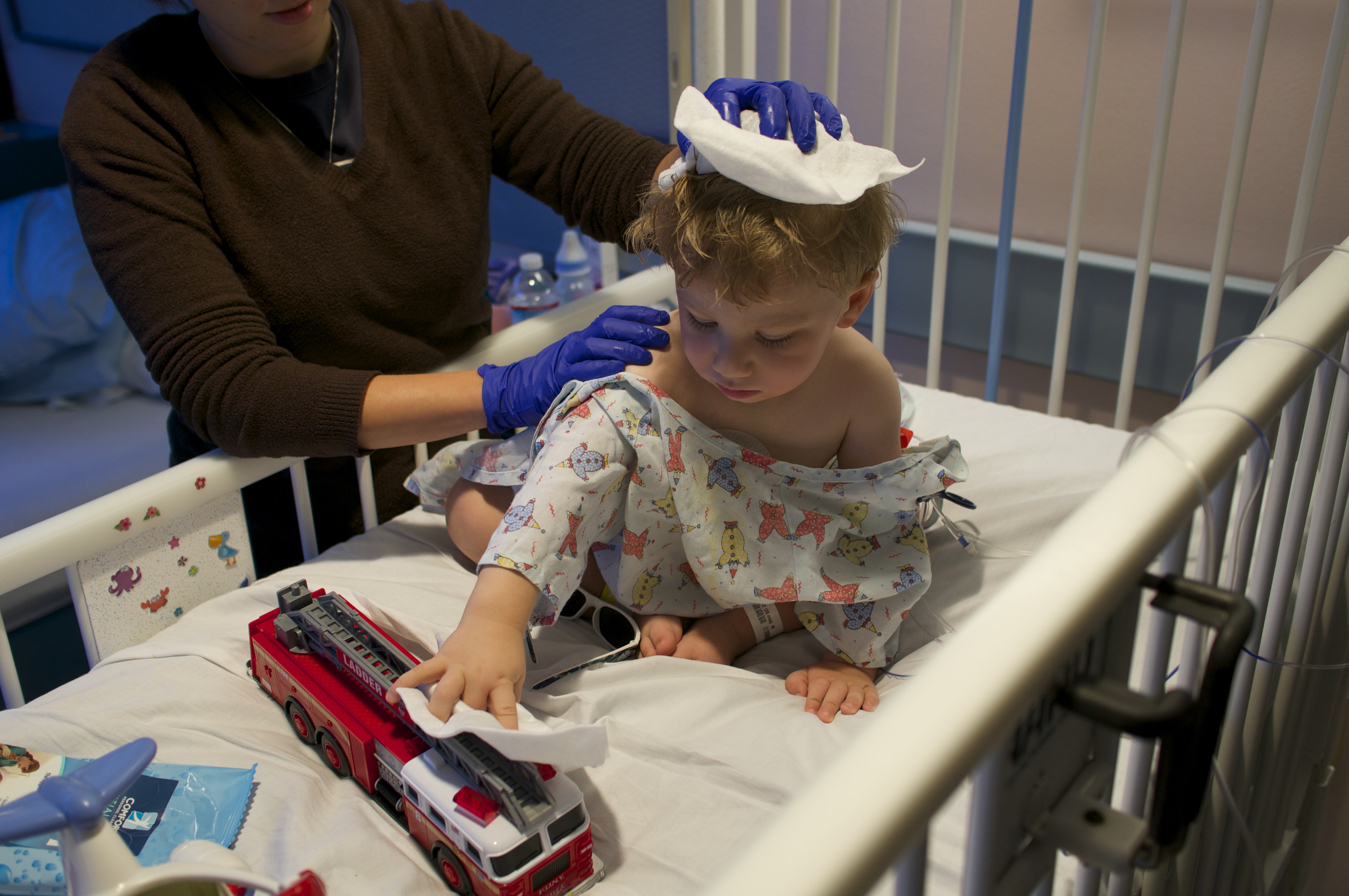
DSC09168We have to give Clark a special clorahexadine bath every day, to ensure we kill any fungus or bacteria that might be growing on his skin.  Clark has decided he likes to wash his truck while I wash him.   That truck is so shiny and clean!

BMT: Aplastic (Day +11)

Clark continues to eat and drink in great quantities, and isn’t showing any signs of mucisitis.  His numbers are at rock bottom and he is susceptible to just about anything, so we are just very lucky that he is in great spirits, eating, and not losing any hair!  In fact, his weight just returned to his admittance weight.  Go Clark!

Clark had a fun day with Grandmom and Daddy today.  Grandmom came out to see Clark while Connor spent the day with Beth.  Clark played on the bed, work on puzzles and had books read to him.  He was delighted to have a change of pace and someone new to play with.

IMG_0026Beth and Connor spent some extra special time together today.  The UCSF Benihoff Children’s hospital is 3 blocks from Golden Gate park.  And it is only a 20 minute walk to a lot of the attractions for kids that are in the park.

Today, Connor got to ride on the Carousel, and visit the California Academy of Science.

The Academy is a “hands-on” museum with tons of exhibits for all ages.  They have some pretty cool attractions.  One of cooler ones is the “shake house“!  This is a simulator that lets you feel what 2 historical earthquakes feel like.  The two earthquakes it simulates are the 1989 Loma Prieta (6.9 on the Richter scale), and the great San Francisco earthquake of 1906 (7.9 on the Richter scale).   After our 6.0 Earthquake in Napa Valley a week ago, Connor has been very interested in earthquakes.

This visit to the Academy was especially exciting for Connor.  He has been persistently asking his Mom and Dad for an opportunity to see dinosaur bones.  Sure enough, as soon as they walked in the door, what to Connor’s wondering eyes should appear?

Dinosaur bones!!
Dinosaur bones!!

A full size tyrannosaurs Rex skeleton!  His facial expression says it all:

Happiest.
Boy.
On.
Earth.

BMT: Aplastic (Day +10)

Today was another wonderful “boring” day. Clark is in a great mood. Flirting with the nurses and insisting the doctor listen to his knees instead of his heart with the stethoscope.

There is a  psychiatric ward a floor or 2 below us.  They have a kind of outdoor “compound”, enclosed with high walls and barb wire.  Our guess is that their stay isn’t 100% voluntary.  We are still trying to figure out what type of behavior the patients exhibit to be admitted (more on this as we find out).

IMG_0401.JPG
Why do those patients get time outside? Haven’t I been a good boy?

Their “rooftop patio” is equipped with a basketball hoop, badminton net and some lounge chairs. We try to align Clark’s “window time” to see the psych patients playing. Sometimes they look like they are in a medicated lull, but today they were more lively and we had fun watching them play! There was even a patient playing guitar. Too bad our windows don’t open, because it would have been nice to listen.

BMT: Aplastic (Day +9)

Clark’s white blood count (WBC) continues to approach zero, as expected. The drop is a result of the conditioning (chemo) from Day -10 to  0. Once it bottoms out, and the new marrow starts to engraft, we will slowly see his counts rise again.

With his low, or absent WBC, Clark is prone to illness. This includes viral, bacterial and fungal infections. Right now, Clark is in the “danger zone”. His body is unable to fight off a mild cold, let alone anything more serious.

Clark has received an allogenic transplant. Meaning he is using marrow from someone other than himself. Patients undergoing allogeneic transplantation are at a greater risk of infection because of a longer time to achieve engraftment (prolonged neutropenia) and the added risk of GvHD.

Engraftment is the process in which the transplanted stem cells find their way to the bone marrow spaces in the centre of the large bones of the body. Only then can the transplanted stem cells begin to produce new blood cells. Engraftment happens in stages:

The first sign of engraftment is the gradual rise of Neutrophil (WBC). This can occur as early as 10 days after transplant but is more common around 14-20 days.

Shortly after Clark’s WBC starts to show signs of engraftment, his platelet counts will start to rise. A platelet count of 20,000 to 50,000 is a sign of platelet engraftment.

Lastly, we have red blood cells (RBC). The engraftment of RBC’s Usually occurs a couple of weeks after everything else. There is no “exact” time frame for engraftment to occur. Many things play a roll in how Clark’s body reacts, such as his specific disease, his age, and the quality of his old blood cells.

While there are many risks involved in Clark having a bone marrow transplant, the hope is the benefits outweigh the risks. In Clark’s case, without a BMT, he would most definitely die at a very young age. But thankfully, with a successful transplant, Clark can at least live a life without the need of regular blood transfusions.

BMT: Aplastic (Day +8)

Clark had a full day of….FUN!

After Clark ate a full breakfast, we had a “surprise” visitor…  Let’s call him “The Book Fairy”. The book fairy came and read stories to Clark!  Only moments after story time was over, the “Music Man” arrived. Clark was serenaded, and given musical instruments of his own to play along. And that’s not the end of it…

Next was Physical Therapy. This may sound like work, but for a child who is not in physical pain, this is actually closer to “playtime”. They walked around the room, climbed on my bed, and basically just played around! All the excitement of the day made for an easy transition to nap time.  This was probably the most “full” day Clark has had since he came into the hospital.

About 2 weeks before Clark came to UCSF, he had a mandatory dental exam. The purpose, was to identify potential sources of oral infection that can lead to bacteremia (bacteria in the blood). It is important to prevent or eliminate dental infection before chemotherapy or other medications that lower the ability of the body to fight infections. Severe gum disease, tooth decay, tooth abscesses and poor oral hygiene can lead to pain and/or bacteremia before, during and after chemotherapy. Thankfully Clark had a clean (dental) bill of health.

It is extremely important to keep the mouth clean and healthy during the bone marrow transplant procedure to help reduce the risk of infection and bleeding. Research has shown that mouth sores are less severe in people with excellent oral hygiene. Some of the preventative medications Clark is on are usually very effective in lowering the risk of viral and fungal (thrush) infections in the mouth as well as in other areas of the body. Fewer infections in the mouth results in less pain and better nutrition.

DSC09020
Clark being silly while Mom brushes his teeth.

With that in mind, one of Clark’s daily rituals, is brushing his teeth! Unlike big brother, Clark actually loves brushing his teeth. This is wonderful, since we have to brush them 4 times a day! He uses a new disposable sponge brush each time he brushes, and instead of toothpaste, Clark uses Sodium Bicarbonate (basically a liquid baking soda)….which, oddly, he likes the taste. Flossing and the use of a normal toothbrush are not recommended when the platelet count is lower than 50,000. To date, Clark has had no signs of mouth sores!