BMT: Isolation (Day +14)

We had a little surprise today. When Clark’s numbers from his daily blood tests showed up, he had a number greater than zero for his ANC (absolute neutrophil count).  ANC is effectively a number that is calculated based on white blood count (WBC) times neutrophils.  ANC represents the virus fighting power in Clark’s blood.

Needless to say, those cells can’t be transfused, so they only come from one place… Clark’s bone marrow!! Today, Clark’s ANC was 140, up from 0 just a couple of days ago.

Is this engraftment? Technically, no.  The doctors consider it engraftment once Clark’s ANC  reaches 500 for 3 consecutive days.  But is this a good sign? Absolutely YES!  The ANC will continue to fluctuate as we go forward, we just need to see an upward trend over multiple days.  If tomorrow Clark is only at 50, that is fine and is still completely normal.

We had another milestone today; Clark started Cellcept orally! He had been taking it through IV, but they decided to switch him over based on his great progress. Most kids start switching to oral meds a bit later in the process,  due to mucositis or nausea, which lead to emesis. Clark has had a few bouts of emesis, but nothing serious enough to prevent him from taking oral medication.

Clark also had a visit from the speech therapist (ST) today. Clark is now 21 months old, but isn’t saying any words. We thought it might be a good idea to see a ST to evaluate Clark, and to learn if there are ways we can help him out.  Personally, I wasn’t too concerned since Connor was about 24 months when he decided to start speaking. But, since we are here, and the ST was available, I thought this might be a good time for an evaluation.

TIL a ST does a lot more than teach someone how to speak, they find out WHY they aren’t speaking. For example, if Clark was deaf, he would have more difficulty learning to speak than others. There can also be physical ailments such as a cleft tongue or a voice box that isn’t fully developed. Or there is the possibility of a mental disability that can hinder speech.

Thankfully, in Clark’s case, it just seems to be a slight delay in speech, unrelated to a more serious problem. He does not have any hearing loss. He can make sounds, proving that it isn’t a physical problem, and he fully comprehends what we are saying. I was given some tasks to preform for a few months, or until Clark starts speaking. We will continue to teach him names of body parts, learn animal names (from looking at pictures) and make sounds together. We can make animal sounds or have him copy simple sounds that I make. All in all, this feels more like a game instead of work. :)

BMT: Aplastic (Day +13)

Yesterday, Clark’s red blood cell (RBC) count was 8.0. We were expecting to give him a RBC transfusion today, but surprisingly his RBC count was 8.3 today! Even though this may look like engraftment, it most likely isn’t since RBC are one of the last blood cells to take hold. What most likely happened, is the small sample of blood that was taken yesterday just happened to have slightly less RBC’s than today’s. Nothing more. Don’t be discouraged though. In my mind, the less transfusions he has, the better.

Clark is still looking and feeling great! Today was slightly less boring than normal, since he had a small episode of emesis this afternoon. Oddly, immediately after we changed his sheets and cleaned up, Clark immediately asked to eat!

Clark was also visited by the physical therapist, book fairy and the music man today! He even learned a few cords on the guitar!

BMT: Aplastic (Day +12)

Happy Labour Day!

Patrick, Clark and I spent the day together.  While Patrick and I were talking today, we did a quick calculation.  Including our first 2 surgeries to fix Clark’s mysterious bacterial infection and put in the 2 lumen broviac, as well as the BMT, we have been in hospitals for almost 35 consecutive days!!  Wow, it has been a long time.  Lots of ground covered, but still lots to go!

We are now in the “zone” for engraftment.  There are no expectations for how soon we might see the new bone marrow take root, but somewhere around 14 days, give or take, we expect to see Clark’s neutrophils and ANC rise.  Today was the start of the “earliest” we could expect to see signs.

Once we see growth we move into the next phase, called “Isolation”.  Isolation starts at the hospital, but continues at home for months after we leave.  More on this in the coming weeks – but think of it like “house arrest” with the family. Ha, ha…

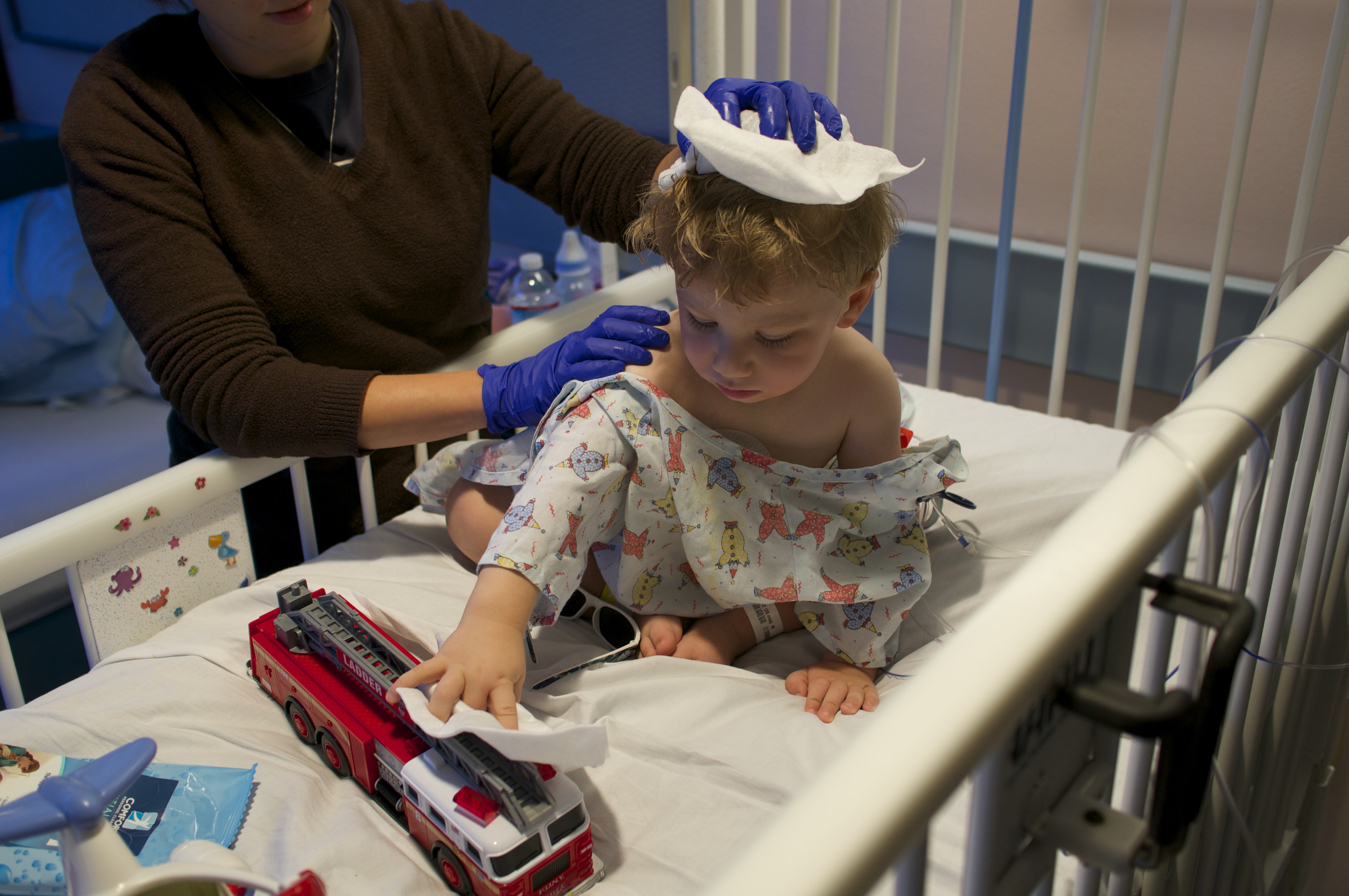
DSC09168We have to give Clark a special clorahexadine bath every day, to ensure we kill any fungus or bacteria that might be growing on his skin.  Clark has decided he likes to wash his truck while I wash him.   That truck is so shiny and clean!

BMT: Aplastic (Day +10)

Today was another wonderful “boring” day. Clark is in a great mood. Flirting with the nurses and insisting the doctor listen to his knees instead of his heart with the stethoscope.

There is a  psychiatric ward a floor or 2 below us.  They have a kind of outdoor “compound”, enclosed with high walls and barb wire.  Our guess is that their stay isn’t 100% voluntary.  We are still trying to figure out what type of behavior the patients exhibit to be admitted (more on this as we find out).

IMG_0401.JPG
Why do those patients get time outside? Haven’t I been a good boy?

Their “rooftop patio” is equipped with a basketball hoop, badminton net and some lounge chairs. We try to align Clark’s “window time” to see the psych patients playing. Sometimes they look like they are in a medicated lull, but today they were more lively and we had fun watching them play! There was even a patient playing guitar. Too bad our windows don’t open, because it would have been nice to listen.

BMT: Aplastic (Day +9)

Clark’s white blood count (WBC) continues to approach zero, as expected. The drop is a result of the conditioning (chemo) from Day -10 to  0. Once it bottoms out, and the new marrow starts to engraft, we will slowly see his counts rise again.

With his low, or absent WBC, Clark is prone to illness. This includes viral, bacterial and fungal infections. Right now, Clark is in the “danger zone”. His body is unable to fight off a mild cold, let alone anything more serious.

Clark has received an allogenic transplant. Meaning he is using marrow from someone other than himself. Patients undergoing allogeneic transplantation are at a greater risk of infection because of a longer time to achieve engraftment (prolonged neutropenia) and the added risk of GvHD.

Engraftment is the process in which the transplanted stem cells find their way to the bone marrow spaces in the centre of the large bones of the body. Only then can the transplanted stem cells begin to produce new blood cells. Engraftment happens in stages:

The first sign of engraftment is the gradual rise of Neutrophil (WBC). This can occur as early as 10 days after transplant but is more common around 14-20 days.

Shortly after Clark’s WBC starts to show signs of engraftment, his platelet counts will start to rise. A platelet count of 20,000 to 50,000 is a sign of platelet engraftment.

Lastly, we have red blood cells (RBC). The engraftment of RBC’s Usually occurs a couple of weeks after everything else. There is no “exact” time frame for engraftment to occur. Many things play a roll in how Clark’s body reacts, such as his specific disease, his age, and the quality of his old blood cells.

While there are many risks involved in Clark having a bone marrow transplant, the hope is the benefits outweigh the risks. In Clark’s case, without a BMT, he would most definitely die at a very young age. But thankfully, with a successful transplant, Clark can at least live a life without the need of regular blood transfusions.

BMT: Aplastic (Day +8)

Clark had a full day of….FUN!

After Clark ate a full breakfast, we had a “surprise” visitor…  Let’s call him “The Book Fairy”. The book fairy came and read stories to Clark!  Only moments after story time was over, the “Music Man” arrived. Clark was serenaded, and given musical instruments of his own to play along. And that’s not the end of it…

Next was Physical Therapy. This may sound like work, but for a child who is not in physical pain, this is actually closer to “playtime”. They walked around the room, climbed on my bed, and basically just played around! All the excitement of the day made for an easy transition to nap time.  This was probably the most “full” day Clark has had since he came into the hospital.

About 2 weeks before Clark came to UCSF, he had a mandatory dental exam. The purpose, was to identify potential sources of oral infection that can lead to bacteremia (bacteria in the blood). It is important to prevent or eliminate dental infection before chemotherapy or other medications that lower the ability of the body to fight infections. Severe gum disease, tooth decay, tooth abscesses and poor oral hygiene can lead to pain and/or bacteremia before, during and after chemotherapy. Thankfully Clark had a clean (dental) bill of health.

It is extremely important to keep the mouth clean and healthy during the bone marrow transplant procedure to help reduce the risk of infection and bleeding. Research has shown that mouth sores are less severe in people with excellent oral hygiene. Some of the preventative medications Clark is on are usually very effective in lowering the risk of viral and fungal (thrush) infections in the mouth as well as in other areas of the body. Fewer infections in the mouth results in less pain and better nutrition.

DSC09020
Clark being silly while Mom brushes his teeth.

With that in mind, one of Clark’s daily rituals, is brushing his teeth! Unlike big brother, Clark actually loves brushing his teeth. This is wonderful, since we have to brush them 4 times a day! He uses a new disposable sponge brush each time he brushes, and instead of toothpaste, Clark uses Sodium Bicarbonate (basically a liquid baking soda)….which, oddly, he likes the taste. Flossing and the use of a normal toothbrush are not recommended when the platelet count is lower than 50,000. To date, Clark has had no signs of mouth sores!

BMT: Aplastic (Day +7)

A vital part of Clark’s care revolves around his central line, aka double lumen broviac. This line is key to Clark receiving his medicine and having blood drawn. Without this, Clark would be covered in holes and bruises from ongoing attempts to put IV lines in his arms, legs, or anywhere else they might have luck getting a vein.  The double lumen broviac has 2 lines, one red and one purple.

A couple of days ago, Clark’s red line (the one they typically use to draw blood) started to feel sluggish. Instead of having an easy time drawing blood, there was resistance. And over the days it only became more resilient.

To prevent clotting in the line, Clark has a “maintenance” drip of saline constantly going into both line when there are no medicines being administered. The resistance in his line is most likely from blood clotting in his line, or from a medicine that leaves residue inside the lining of his tube.

Instead of waiting until nothing would draw at all, it is best to do something to clean it out ASAP. At home, when there are no maintenance IV lines pumping liquid through, we do a Heparin lock (aka “Heplock”). Heparin fills the line and helps prevent clots from forming. We would do a Heplock every 24 hours. In this case, we already had a clot or build-up, so we needed something stronger to clear it up. So last night we put tissue plasminogen activator (TPA) in his line for two hours. TPA is a protein involved in the breakdown of blood clots. This is only used in the line, and does not enter his body. Once the TPA has been in the line for approximately 2 hours, it is drawn back out with a syringe. So today, after using the TPA, his line is clean as a whistle!

Today was another great day! The nurses and doctors believe Clark is having very mild side effects of the chemo.  We’ll take that… and we are grateful for it.

DSC09016
Nachoooooo Libre

So many of you have been asking about the plane that scared Clark. Well, here it is.  It definitely isn’t the friendliest looking thing, that is for sure. We think it’s the engine sounds frightens him.  No worries, say the word little man, and I’ll get Daddy to take this to a quiet farm up in Northern California, where it will live out the rest of its days playing in the fields and sunshine.

BMT: Aplastic (Day +6)

Day +6 started REALLY early for us.  At 1:30am, Clark started whining, sat up, and started emeses (plural form of emesis). Thankfully this was short lived, and he fell back to sleep once we changed his sheets.

DSC08941
Clark loved the car-go-round

Clark had an exciting morning while playing with the Child Life Specialist. They played with puzzles and a toy car slide while sitting on a large mat on the floor. There was also a cool airplane that made flying sounds. For some reason the airplane freaked Clark out! Once he started using the “all done” sign, I decided it was best to hide the airplane in the closet. :)

Throughout the morning, I have noticed a small rash on Clark’s body that comes and goes. At first it was on his inner thighs, then his back, followed by his cheeks. One minute they will be there, the next they are gone. A rash can be a sign of GvHD, so I told the doctor once he came in the room to do his rounds.

But not this time… I was told the GvHD doesn’t usually show up until the engraftment stage (still about 2 weeks out). So the doctor isn’t worried about this rash being GvHD.  Instead, there is a chance this could be something called Peri Engraftment Syndrome (ES). It was described to me as a slight reaction to the new bone marrow. This can cause an unknown fever, rash, and occasionally inflammation of the lungs. This is usually treated with corticosteroids. Once treated, it usually lasts 1-5 days. We are not at the point of starting corticosteroids yet, because we are not sure if ES is the culprit.  More watching, more waiting…

BMT: Aplastic (Day +5)

While Clark is in the hospital building up his immunity, he is on a long list of IV fluids and medicines. One of his many transitions in preparation for going home, is to switch his IV medication to oral meds (can you imagine us at home with an IV pole? No way!) Today was Clark’s first switch! He started his Cyclosporin (Neoral) orally at 7am, and will be given this every 8 hours for the next few months.

Clark’s Neoral levels will be closely monitored until the doctors feel he is getting the proper dose before going home. Cyclosporin helps prevent GvHD, but there is definitely too much of a good thing when it comes to this medicine.  Side effects from too much Neoral include damage to the liver and kidneys. It can also cause elevated blood pressure, shakiness and rare cases, seizures.

We also meet with the nutritionist weekly. She makes sure Clark is eating enough foods and gives advice on how to increase his calorie intake. If Clark stops eating, he will be put on an IV nutritional supplement. Loss of appetite could be due to mouth sores called mucositis, or from nausea. Both are common short term side effects caused by the damage done by the chemo.

We would prefer to avoid IV nutrition, or at least prolong his eating as much as possible. We can help prolong his intake by “giving in”, and feeding him cookies and ice cream for dinner! The nutritionist has some better/healthier ideas, such as adding sour cream to his soup or drinking pediasure as a supplement. I am not a huge fan of high fat or high sugar diets, but I would prefer this (for the short term) to using IV supplements since they can have a host of side effects including GI issues, liver damage and more.

Overall, Clark’s day was quiet without any (obvious) nausea. Here’s a interesting word of the day for you… “Emesis” is the medical term for vomit.  Doesn’t that sound nice?  Clark was emesis free today.  Clark’s nemesis is emesis.  Ha, ha…

Clark had a long nap this afternoon and finished out his day with a fun visit with daddy.

BMT: Aplastic (Day +4)

This is the dreaded Day +4.  This marks the starting of Clark’s lowest counts. This is the beginning of when we expect to see his negative reactions to the chemotherapy, as well as when he is the most susceptible to infection.  It is also the ideal opportunity for the new bone marrow cells to start growing.

Patrick and I had the opportunity to go outside and grab some lunch this afternoon. Clark has just fallen asleep, and we had an hour and a half until he needed his next set of oral meds. We made sure the crib railings were secure. The nurses turned on the camera and sound for the room, and we were on our way!

It was such a beautiful day outside, with the sun shining and a cool breeze blowing. The neighborhood around UCSF is very San Francisco-esk with the tall 3 story homes and the steep hills. We made it to a nearby taqueria and had just enough time to order our burritos when my phone rang.

It was the hospital… Apparently (in the 15 min we had been gone) the nurse had to turn Clark over because he was squishing an IV line (this happens often). Clark started coughing, which turned into full blown vomiting! It sounded like the nurses were having a hard time calming him down, and needed us to come back ASAP!

Luckily, the nurses managed to calm Clark down before we returned. We were very relieved to see this, since Patrick and I were a 15 minute walk away when we received the call! Unfortunately Clark’s nap ended up being only 15 minutes long due to the unkind wake up, and he wasn’t able to fall back to sleep. The night ended with no additional signs of upset stomach, but he was a little grumpy from being sleepy. (Heinrich?)

It’s difficult to tell the reason why Clark started to vomit. It could have been a cough that triggered his rather sensitive gag reflex, followed by the fact that neither of his parents were there to calm him. Or this could have been nausea and vomiting due to his chemo. Clark has a daily drip of anti-nausea medicine. This is needed to keep his stomach calm. But it is very possible that the medicine is not strong enough some days.

So, hopefully an isolated incident, and not the “wrath of Day +4”.  We spent the end of the day playing by the window and enjoying cookies.  If Clark is going to start rejecting food (due to chemo), Patrick and I decided we should start including foods he never says “no” to.  That way we can see if the problem is the type of food, or his stomach.  Cookies and ice cream accompany every dinner because of this.  Plus… YOLO, hombres!